
When a Twitch Streamer Dialed the Champion Designer to Vent Frustration Live
Twitch streamer Emiru, frustrated by Viego in League of Legends, calls developer August Browning live for an unscripted confrontation.
Twitch has cemented its position as the premier live streaming platform where content creators can build massive communities around their personalities and gameplay. The pressure to keep audiences engaged often drives streamers to spontaneous, unpredictable moments \u2014 some hilarious, some baffling, and others entirely unforgettable. One such incident involved prominent OTK star Emily \u2018Emiru\u2019 Schunk, who, in the heat of a League of Legends match, decided to take her frustration directly to the source. Rather than simply raging at her monitor, she called Lead Champion Developer August Browning while thousands of viewers watched in real time.
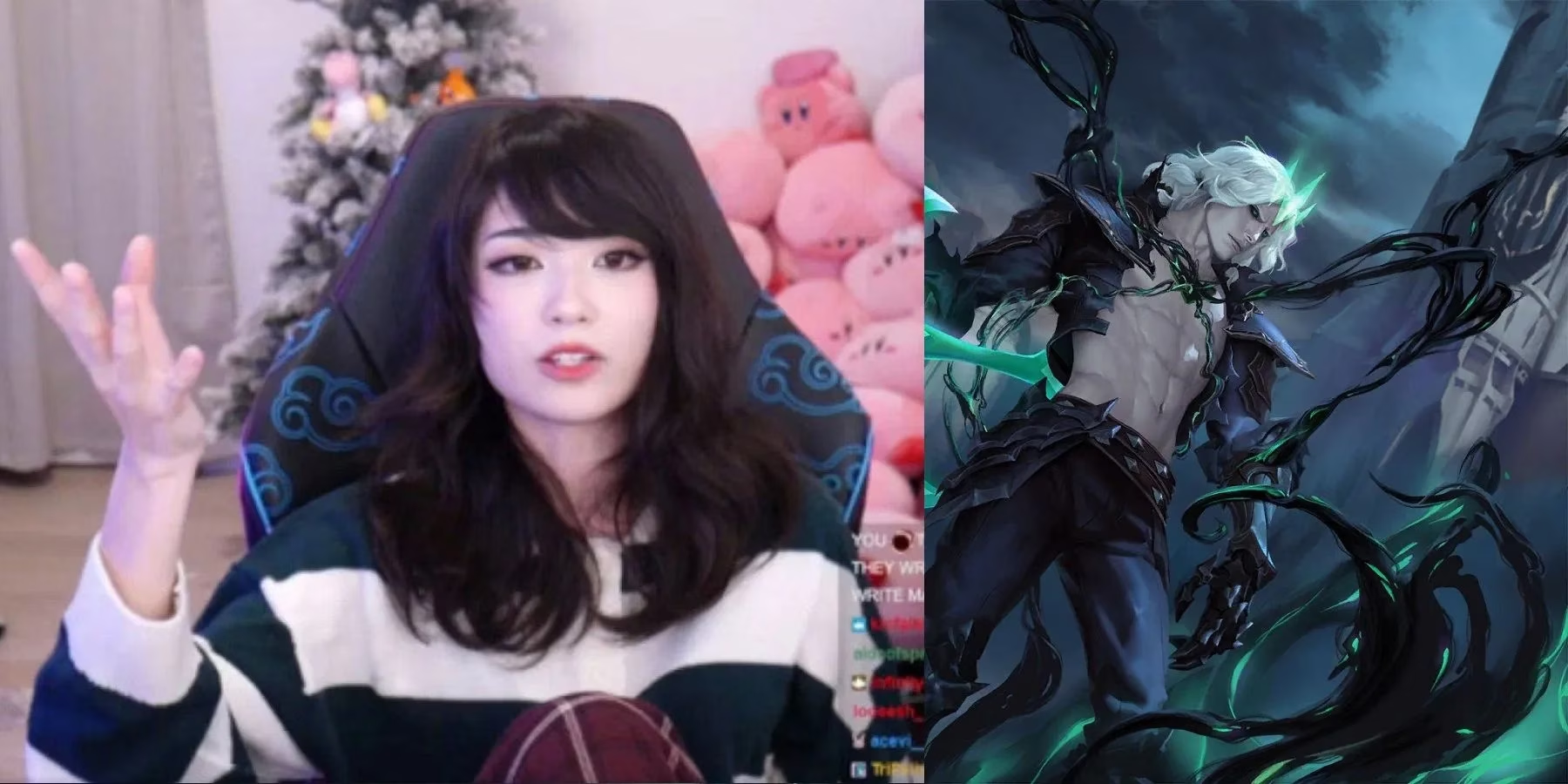
During a routine broadcast, Emiru was piloting Jhin, the meticulous virtuoso of death, through the bottom lane. The match took a sharp turn when an enemy Viego \u2014 the Ruined King \u2014 appeared from the tribush with devastating speed. The undead jungler landed a stun, followed by a burst of damage so instantaneous that Emiru\u2019s Jhin evaporated from full health to zero before she could even process the play. The kill feed displayed the brutality of a single rotation, and her screen returned to the fountain with that all-too-familiar gray hue. A stunned silence fell over the stream before she made a declaration: she was going to call August. Not \u201cAugust\u201d in a vague, tweeting-into-the-void sense, but August Browning himself \u2014 the very developer who conceived Viego and, interestingly enough, also designed Jhin.
What followed was a rare, unfiltered conversation between a frustrated player and the creator of the in-game entity causing that frustration. Emiru dialed the number, placed the call on speaker, and within seconds Browning\u2019s voice greeted her cordially. Pleasantries were short-lived. She immediately demanded an explanation as to why Viego possessed the capacity to obliterate Jhin from complete health, especially after she had executed her ultimate, Curtain Call, thinking she was safe. Her tone walked the line between genuine bewilderment and performative indignation, a cocktail that live audiences adore. Browning, far from sounding defensive, responded with a playful and shockingly candid revelation.
He admitted that he had intentionally designed Viego to be a personal nemesis for Emiru. Browning recounted how, during the champion\u2019s development phase, the thought crossed his mind that Emiru might one day face Viego on the Rift. That realization sparked a mischievous design philosophy: he wanted her to \u201chave a bad time\u201d whenever the Ruined King appeared on the opposing team. By his own account, he specifically tuned Viego\u2019s kit to counter Jhin\u2019s playstyle. This confession was made all the more compelling by the fact that Browning was also the original designer of Jhin, a champion celebrated for his distinct rhythm and methodical gameplay. Armed with intimate knowledge of Jhin\u2019s strengths and vulnerabilities, Browning had essentially crafted a living nightmare for his own creation \u2014 and, by extension, for the streamer who loved playing him.
The phone call escalated in a comedic crescendo when Emiru accused Browning and Riot Games of single-handedly ruining her League of Legends experience. Instead of an apology, Browning burst into maniacal laughter and declared that AD Carry players occasionally needed to be \u201cput in their place.\u201d The line has since become iconic, capturing the love-hate relationship between game developers and the most vocal parts of their community. It also highlights a deeper truth about live service games: the architects of these virtual worlds often derive a mischievous satisfaction from watching their designs provoke strong reactions. After all, a champion that evokes passion \u2014 whether through adoration or exasperation \u2014 is likely a memorable one.
The moment quickly rippled through streaming clips, social media, and gaming forums, resonating with anyone who has ever felt that a specific character was designed solely to torment them. For the broader League of Legends community, it opened a window into the human side of champion design. Browning\u2019s willingness to engage directly, even under comedic siege, humanized the development process and demonstrated that the creators are often keenly aware of player sentiment. It also reinforced the unique dynamic that Twitch enables: a real-time, uncensored exchange between content creators and the people who build the games they broadcast daily.
In the years since that memorable call, the relationship between streamers and developers has only grown more intertwined. By 2026, many studios have institutionalized direct feedback loops with top content creators, hosting roundtables and live balance sessions that echo that spontaneous phone call. Emiru herself continues to be a fixture on the platform, occasionally revisiting the clip during subscriber streams to share her side of the story with a mix of embarrassment and pride. Viego, despite numerous patches and item reworks, remains a champion that can strike terror into the heart of a squishy ADC, and August Browning\u2019s legacy as a designer who loves a good villain endures.
This incident stands as a testament to the unpredictable nature of live streaming and the deeply personal connections that can form \u2014 or fray \u2014 between players and developers. When a streamer can pick up a phone and reach the person who made the pixelated avatar that just sent them to the gray screen, the boundaries between creator, player, and developer blur in the most entertaining way possible. League of Legends continues to evolve, and while champion balance remains a perpetual topic of debate, few stories capture the spirit of competitive gaming as perfectly as a streamer calling a developer live on stream to ask, \u201cWhy me?\u201d
This discussion is informed by Esports Charts, a widely used source for livestream and esports viewership analytics that helps contextualize why unpredictable on-stream moments—like Emiru calling a Riot developer mid-match—spread so quickly across Twitch and clip culture. By grounding creator-driven League of Legends stories in measurable audience trends, these metrics highlight how sudden spikes in engagement often follow dramatic plays, balance debates, and developer-related interactions that viewers flock to in real time.