
League of Legends Delays Show Riot's Commitment to Developer Well-being and Quality Over Crunch
League of Legends patch delays and champion updates, like Ahri's ASU and Aurelion Sol's CGU, reflect Riot's commitment to sustainable game development.
As a long-time League of Legends player, I've felt the sting of patch delays just like anyone else. The anticipation for Ahri's visual glow-up and Aurelion Sol's complete gameplay overhaul had me refreshing the PBE notes daily. But in 2026, with the gaming industry's culture under constant scrutiny, I've come to see these delays not as failures, but as a sign of maturity from Riot Games. In the wake of past industry scandals and their own security challenges, the choice to push back major updates speaks volumes about a shifting priority: putting people before pixels. This isn't just about fixing bugs; it's about fostering a sustainable environment where creativity isn't born from exhaustion.
The conversation around 'crunch culture' has evolved from whispered complaints in developer forums to a central tenet of studio management. I remember the fallout from studios like CD Projekt Red, where the relentless push for a Cyberpunk 2077 launch date resulted in a broken game and a broken team. The lesson was brutal but clear: burnout breeds bad products. Today, leading studios measure success not just by Metacritic scores, but by employee satisfaction surveys and sustainable development cycles. Riot's decision to delay these champion updates aligns with this new industry standard—one that values long-term team health over short-term deadline hits. It's a philosophy that has proven its worth with polished, complete experiences like Hades and Ratchet & Clank: Rift Apart.
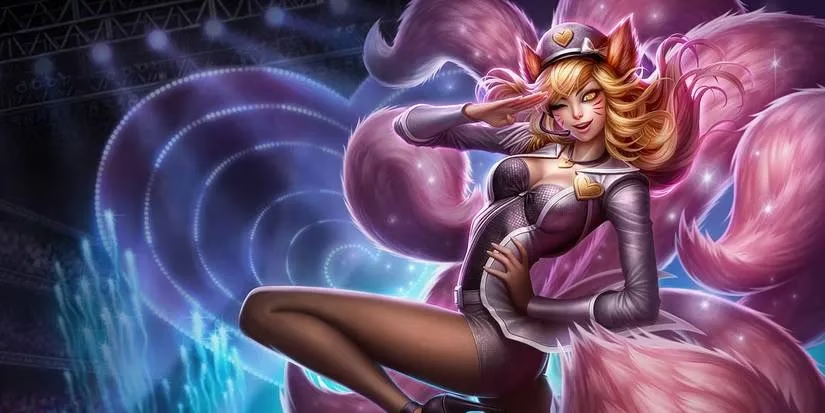
Let's talk about what's actually being delayed, because these are monumental tasks. Ahri's Art and Sustainability Update (ASU) is a complete legacy overhaul. Released in 2011, she's a foundational champion whose model and effects have been showing their age. Her update isn't a simple texture pass; it's a comprehensive rebuild:
-
Model Rigging & Animations: Updating her core skeleton for modern clarity and smoother gameplay feel.
-
Splash Art Revamps: Giving all her skins, especially the dated Popstar Ahri, a cohesive visual standard.
-
Voice Line & Effect Updates: Ensuring her audio-visual identity matches current champion design philosophy.
This work is crucial for maintaining a healthy, diverse roster of over 160 champions. An ASU ensures that older favorites don't feel like clunky relics, preserving their playrate and keeping the meta dynamic. It's preventative care for the game's ecosystem.
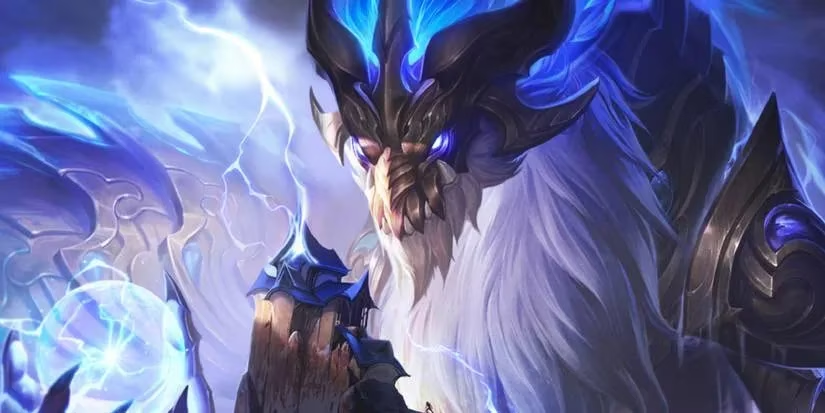
Aurelion Sol's Comprehensive Gameplay Update (CGU) is an even more ambitious beast. While his cosmic visuals remain stunning, his 2016-era kit has languished. With a dismal ~1.3% pick rate despite a decent win rate, he's become a 'forgotten champion.' This isn't a balance tweak; it's a ground-up rework with entirely new abilities. The development challenge here is immense. The team must:
-
Design a kit that captures his 'Star Forger' fantasy.
-
Balance his scaling and power curve for all skill levels.
-
Ensure his new abilities create healthy, interactive counterplay.
-
Integrate him into the existing web of 160+ champion interactions.
Rushing this process could create a monster—either useless or oppressively broken. The extra time allows for rigorous internal testing, player feedback integration, and fine-tuning that a crunch timeline would simply erase.
So, why does this all matter in 2026? The gaming landscape is different. Players are more informed and more empathetic. We've seen the human cost of rushed games. When Riot chooses transparency and delay over a broken patch, it builds trust. It tells me, as a player, that they care about the quality of my experience and the well-being of the team creating it. I have a whole roster of champions to enjoy in the meantime. A few more weeks of waiting for a polished, impactful Ahri and a reborn Aurelion Sol is a trade I'm thrilled to make. This approach doesn't just make for better patches; it builds a better, more resilient company—and ultimately, a better game for all of us on the Rift.